Friday, May 11, 2012

Making Art By Ulster’s Sperrins: Q&A With Aine MacAodha

Aine MacAodha is Irish for Ann Keys, who was born in 1963 in the small town of Omagh, Tyrone County, in Northern Ireland. Aine is a writer, a poet, a photographer and artist, and has been published widely in Ireland, United Kingdom and the United States.
 
MacAodha lives at the foot of the Sperrin Mountains -- her inspiration in any season. She has two poetry books published: “Where the Three Rivers Meet” and “Guth An Anam” (“Voice of The Soul”). 
 
Aine started writing poetry as a child, when she also became enamored with photography. Between her mother’s collection of ballad books, which intrigued her, and her inquisitiveness about her father’s darkroom in the family home, she was destined to become the accomplished ‘poet-ographer’ that she is today.
 
A mother of three grown children, MacAodha is also an artist not afraid of taking chances. She personifies the key ingredient for achieving unique beauty in her work; that is, not necessarily doing different things, just doing things differently. She is drawn to mountain ranges, old ruins, churches, castles, Celtic burial sites and rural scenery. She is a master at pairing images with her poetry.
 
The true genius of her work is the timeless quality of it, much like Ireland itself. MacAodha is able to capture the spirit of nature and emotion in words and through the lens of her camera. We e-mailed her some questions, which she addressed hard by the Sperrins that so inform her muse.– WG Visual Arts Producer Maryann Tracy
 

The Wild Geese: Have you always had an interest in both poetry and photography?


Aine MacAodha
Aine MacAodha: I always had an interest in rhyming words and phrases together, loved reading and often upon reading old ballad books my mother collected, changed the words to suit my own, this [taught] me the ballad form but my love of photography started as soon as I realized what father was doing, he had a darkroom and developed his own photographs. I was always at his sleeve questioning everything.


The Wild Geese:  Which came first? When did you decide to combine the two?

MacAodha:
I suppose poetry came first; growing up, songs surrounded the home and poetry and song are very alike to me. The combination was always there; when words fail me I have the camera in hand to capture some of nature’s often-overlooked wonders. Lately, I have combined Haiku with a photograph -- poetography -- if you like, they fit so beautifully together. Haiku are my favorite poem to write, very difficult to get them right; but when I do it’s magical to see them combined on screen.
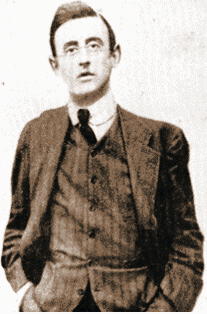
Joseph Mary Plunkett
The Wild Geese:  Are there certain poets that inspire you?
 
MacAodha:
There have been many. The first poets to really inspire me were the 1916 poets, [for example, Joseph Mary] Plunkett; especially his story, I like this poem “I See His Blood Upon a Rose,” and I really admired his wife, Grace Gifford Plunkett. [I was] greatly inspired also by Yeats, Seamus Heaney and the Celtic revivalist era of Yeats, Katharine Tynan, and Alice Milligan, who was a native of Omagh. I also love Rumi, the 13th century mystic poet. I'm very fond of the beat poets of America and read quite a bit lately of Emerson and Whitman. All fascinating.

The Wild Geese: You are obviously tremendously inspired by your surroundings. Tell me about that creative or spiritual feeling you experience when you find that special place, like the Sperrin Mountains.
 
MacAodha: The Sperrin Mountains are my inspiration in any season. Here in Omagh surrounded by the mountains you are never very far from a mountain spring or lough or place of sacred ground, that's the good thing. As I walk out over the Pigeon Top or the lakes area of Gortin Glens, my spirit flies too, the blanket bog soft under foot and surrounding hills and mounds have a supernatural pull for me. It’s instinctual for me to go visit the ancient Beaghmore stone circles or holy wells -- it does the soul good. I feel at home in the solitude of the views.

The Wild Geese:  “Voice of the Soul,” your second book of poetry, published in 2011, includes some haiku that I particularly enjoyed. What is "soul voice"?

MacAodha: 
“Voice of the Soul” was my second book, and I have written quite a few haiku in that collection. Haiku are a beautiful way to write short forms of poetry, I began reading Basho, the Japanese haiku poet, and it had me fascinated [as] it looked so simple yet quite the opposite to do. I was thrilled to have a few published in the Shamrock Haiku Journal and Haiku Ireland.
 
Holy Well, Co. Clare
So back to your question on what is “soul voice.” I think for me its the outpouring of a deep inner knowing or feeling; perhaps love for something beautiful like a poem or a landscape that you feel at home in. Your soul soothes in it. It’s a voice that is intuition and whispers from within -- you need to be very still to hear it.

The Wild Geese: What is the essence of "Where the Three Rivers Meet"?

MacAodha:
“Where the Three Rivers Meet' was my first collection. It took a long time to put [it] together, as I wanted most of the poems within to have been published in as many poetry publications as possible. Many of the poems touch on The Troubles, and growing up amid this, your surroundings were bleak. This collection is an 'awakening,' if you like, to the beauty that surrounds Northern Ireland, now that peace has come it looks and feels more freer and beautiful.

The Wild Geese: Tell me about your poem “Denied.”

MacAodha:
I … was asked to write a poem on [the Cillini – typically, unconsecrated burial grounds for unbaptized babies], and “Denied” was the result. I found this very interesting and heartbreaking, [with] so many parents having to go through this with no support from church and family at that time.

The Wild Geese: Tell me about your involvement with the Derry Playhouse.

MacAodha:
I was involved with the Derry Playhouse back in 2000, under the guidance and facilitation of writer Margie Bernard (author of “Daughter of Derry”), a wonderful woman who I and others met at a creative writing master-class tutored by theatre director David Gothard, held at The An Creggan center here in Tyrone. From that was formed The Derry Playhouse Writers, which is still going as strong today. You can visit the site here at http://derryplayhousewriters.org/ . For me the playhouse opened my mind and gave this country girl a voice. There were weekly meetings and various workshops and master classes, which helped my writing go forward.

The Wild Geese: Is there anything you would like to add?

MacAodha:
At the moment, I am sending new poetry out to magazines, with recent publications in Outburst Magazine and The firstcut [the on-line magazine of the Listowel Writers Group] and I recently interviewed with Frank Hanover of the University College Cork radio show “Words on Top.” On the back burner is a kind of semi-autobiographical book on growing up in Omagh, with the background of music not war. I hope to get to work on that in June when I take up my residency at The Tyrone Guthrie Centre in Monaghan. WG
Barnes Gap, Sperrins Region

Carved centuries ago
by the powerful elements
of wind and ice slicing
through the countryside.
Glazed now by a carpet of moss
and haunted by the hills of
Mullaghbane and Mullaghbolig
seem untouched by modern man;
apart from the odd sheep
that wandered under the fence
leaving clots of wool waving
frantically.
Tense atmosphere only solidifies
the cheek of my intrusion.
Sun plays hide n. seek
behind rocks and crevices
cooling schists once again.


Sperrins


Wednesday, May 2, 2012

Helping The Dead Find Their Voices: Q&A With Historic Graves’ John Tierney

The Dominican Priory - Athenry
John Tierney is the director of the Historic Graves project in Ireland, taking place in historic graveyards across Ireland.  With a combination of GPS, smart phone, and Internet technology, local community groups are documenting individual graves, and creating links between those graves and the stories of their occupants on the project’s website.

John and his partners at Eachtra Archaeological Projects provide the technology and training for local community groups to do the groundwork, a hi-tech meld of archaeology and genealogy research.  Tierney hopes the new technology will enrich the experience of historical tourism in Ireland.

The Wild Geese’s Daniel Marrin e-mailed a few questions to Tierney about his work with the Historic Graves project.

The Wild Geese:  What inspired you to take this project on, John, and how did it get started?

Tierney (left): We have been working on historic graveyards as field archaeologists for the last 15 years, but we felt that conventional surveys were missing the rich oral histories of each graveyard. We built the historic graves website to connect surveys with rich, hyperlocal heritage media.

A geo-located headstone photograph is uploaded to the website and associated stories (audio or video) can be attached to that grave memorial. People have been recording and publishing Irish graveyard memorials for the last 300 years, and we have applied modern technologies to that tradition. We see ourselves as following in the footsteps of those previous researchers -- but digitally enabled. A 5 MP digital photograph of a headstone is a very detailed record: Imagine it also geotagged as searchable within a database!

We are field archaeologists and we apply the techniques we have learned over the years to community training and community surveys. Some people love the project because of its local history benefits; others love the genealogy or the archaeology. We leverage modern technology to benefit each community and at the same time build a scientifically rigorous database.

The project is a collaboration between field archaeologists, local communities, local authorities and local development agencies throughout Ireland. Community groups have long been engaged in recording and caring for their local graveyards, and we provide them with training and digital tool-sets for achieving their goals.


Ardmore, Waterford
WG: When is a grave considered historic?  Are there any graves that would not be historic?

Tierney: Irish historic graveyards are considered to predate the early 20th century. Many of the graveyards we work in are medieval in origin – in some cases encapsulating over 1,000 years of continuous usage. (My own neighboring graveyard in Ardmore, County Waterford, is one of those, and the small graveyard we worked on today in Killea, north Tipperary, may be another.)

Other graveyards we work in may have only been founded in the late 19th century, but headstones from the 1860 to 1920s can tell us a lot about our recent history. We study those also -- in one graveyard we had an Old IRA member buried alongside an officer in the Royal Navy -- these reflect the geopolitical complexities of Irish history. Many Irish graveyards were closed in the 1930s, and we will survey those also. In some graveyards, a modern graveyard exists alongside an historic graveyard and we do not survey the modern graveyard.
 

Kilmacduagh, Co. Galway 

WG: The information on the graves and the stories of their occupants are openly available online.  Given that some people get uptight about even their homes being viewable on Google Earth, I'd imagine there could be even greater sensitivity about such public information about their dead relations. Is the research always being done by friends/relatives of the deceased?  If not, is there any risk of families seeing a violation of privacy in putting this information online? 

Tierney: The surveys are done by the local communities themselves. We address issues of sensitivity by relying upon the judgment and knowledge of the local community groups. Most of the memorials we record are well over 100 years old.  If newer headstones are recorded, it is because they represent the modern usage of an ancient site. We regularly have family members recording their own family graves and telling stories of their ancestors. In the last one-and-a-half years, we have had no complaints about privacy, but if asked to unpublish individual headstones it can be done in an instant.
 
WG: Can you tell me anymore about the headstone you were led to of an apparently 219-year old man in St. John's Graveyard in Knockainey?

Knockainey graveyard
Tierney:  Knockainey graveyard (has been the subject of an excellent survey led by a retired school teacher and field archaeologist named Michael Quinlan. Michael led us to the wonder of the oldest man in Ireland.

People in south Limerick have a reputation for longevity, and maybe this man was the kingpin of longevity. Alternatively, the stonecarver was given bad information or even made a mistake in the carving. Mistakes in headstone carvings are a fascinating side-issue of the project.

WG: John, good luck with the project and thanks for your time!  More information on the Historic Graves project, including links to Irish historic graves, maps and stories, is all available at historicgraves.ie .

Thursday, April 12, 2012

Crooning the Irish Experience: Q&A With ‘Titanic’ Songwriter Padraig Lalor

'The atmosphere was tense Maggie gave the order to row,
They watched the last flares in the night sky glow,
Above the stricken liner on the journey to its grave,
Maggie shouted we must go back there are many more to save' – From Padraig Lalor’s song “Molly Brown”


Singer and songwriter Padraig Lalor, 50, grew up in the Falls Road neighborhood of West Belfast, part of a large Catholic family whose roots lay in Dublin. He studied for a time at Ruskin College at Oxford University and pursued journalism, but says he found his true calling singing and writing music. He accounts among his inspirations Derry-born Irish tenor Josef Locke and Belfast balladeer Kathleen Largey.

Lalor draws greatly from his life experience, knowledge of history, and local and family lore to write his songs. As with the verse above, taken from his first solo album, “Ismay’s Dream,” Padraig seems to have a facility to draw listeners into the drama of the past and bring characters to life. The Wild Geese’s Belinda Evangelista Skyped him a few questions about his muse.

The Wild Geese: Tell me about your fascinating great-grandfather 'Dublin Geordie,' who, like Molly Malone (
below: Her statue in Dublin, Wikipedia Commons), was a street trader selling fruit and vegetables from his horse and cart on the streets of Dublin and on the Belfast docks at the time of Titanic’s construction there.

Padraig Lalor: I only found out about ‘Dublin Geordie’ at my mother’s recent wake. She passed away on March 11. Belfast is full of characters, and my family is no exception. Like many Catholics, Geordie was drawn to Belfast by the opportunities for work both at the shipyards and, of course, serving the needs of the tens of thousands who worked there and their families.

The Wild Geese: I love Dublin Georgie’s character -- is “Ismay’s Dream” in some way dedicated to him?

Padraig Lalor: Interestingly, I have come to know Bruce Ismay through my conversations with (Ismay's) relative Clifford (Ismay), who I often speak with. ‘Dublin Geordie’ and Ismay would have moved in different circles, but like many were brought together by Titanic and the Belfast docks ... just like Clifford and I 100 years on.

The Wild Geese: How did your grandfather Patrick's background -- a Catholic who joined the Royal Artillery and was a decorated veteran of the Second World War -- shape your opinions over the years?

Padraig Lalor: During World War II, conscription did not apply in Ireland. My grandfather Patrick opted to take up arms to fight for freedom. That is a principle that remains very dear to me.

The Wild Geese: I can see why you are known as “Seanachi.” What is you favorite story to tell with your music about the Titanic?

Padraig Lalor: The song “Latitude 51” (the coordinates for Cork) tells the story of a young couple [who took passage on the Titanic] forced to flee the country they love because of prejudice. Ireland is not just a map reference, it’s a spiritual home. The loss of its youth was a tragedy for the country, too. I was inspired by a beautiful Thomas Moore poem:

The harp that once through Tara's halls
 The soul of music shed,
Now hangs as mute on Tara's walls
 As if that soul were fled.
So sleeps the pride of former days,
 So glory's thrill is o'er
And hearts that once beat high for praise
 Now feel that pulse no more!

No more to chiefs and ladies bright
 The harp of Tara swells;
The chord alone that breaks at night
 Its tale of ruin tells.
Thus Freedom now so seldom wakes,
 The only throb she gives
Is when some heart indignant breaks,
 To show that still she lives.

I can almost picture the harp of Tara’s Halls mute, hanging in the silent majesty of Titanic as she rests.

The Wild Geese: What Titanic events are you involved with? Will any of them be outside of Ireland?

Padraig Lalor: We’ll be touring the UK, Ireland and the Channel Islands doing theatres and festivals. I will also be doing storytelling in music and songs.

The Wild Geese: This is an exciting time for Belfast -- are you proud to be part of this great celebration?

Padraig Lalor: Yes, I think it is important for Belfast to remember and mark this event. It’s a very different story from what has been coming out of the city over the past 40 years.

The Wild Geese: What are your plans for coming to America?

Padraig Lalor: I would love to take my storytelling to American audiences. I can work as a solo artist, telling stories through great songs.

The Wild Geese: As a native, where do you recommend Titanic tourists go in Belfast to feel the heartbeat of the city’s music scene?

Padraig Lalor: The Rotterdam Bar in Belfast docks and Kelly Cellars pub, the place where Henry Joy McCracken launched [plans for Antrim’s part in the] 1798 rebellion.

The Wild Geese: Is there anything you would like to add?

Padraig Lalor: All great stories have complex characters, plots and subplots, romance and tragedy. … My Titanic-themed album is more James Joyce than James Cameron and puts the Irish dimension back into the story.

Lalor resides in Swansea, Wales, with his wife and two sons. To find out more, visit http://www.padraiglalor.com/ or http://www.traditionalirishband.com/.
WG

Sunday, March 25, 2012

Seeking Brother, Traveller Father on Both Sides of the Irish Sea

The two Sheelagh Gunns and Prince
At 5 years of age, Sheelagh Gunn recalls, she was dangled over the murky waters between the Belfast dock and the ferry by an aunt who said "We don't want this Protestant bastard." The only thing holding her in her camel-haired coat was good waxed cotton and leather.

Meanwhile, her beloved baby brother Robert, screaming her name, was carried off by his father never to be seen by Gunn or her mother again. Her great grandmother 'Granny McCulloch' would say of Sheelagh, when she was but two years old, "The child has the sight," and of course that would be true to her birthright, the caul or veil with which she was born, a sign of a mystic seer -- a path preordained before her birth and one which she still honors.

The story that accompanied her in childhood was "a baby born with a caul (a veil) and two toes webbed, a 'fey' child," the old folk would say, Sheelagh's mother being a 'wild' child with webbed toes, long flowing hair and a pixie spirit. The child's birth presents consisted of a border collie named Prince and a lamb called Buttons.  She was always referred to as the "child" for no one truly knew her father. Or did they?  "It's the gypsy in that caravan," some would say (the dark mysterious stranger from Ireland) or was it someone of the local gentry as "the 'child' would have provisions made for her."
Granny McCulloch and Armistice (Nana)


Sheelagh Gunn was so moved by our Belfast cillini limbo babies interview she contacted us, and shared a promise she made to herself after her mother passed to find her half-brother.

"I have been told that I spent the first 3 years of my life with Nana in the village of Loans Ayrshire Scotland, just south of Irvine.  I truly believe my mother may have stayed there, too, until Bob came along," she wrote.

When Sheelagh was about 3 years old. her mother, Jesse, who was also known as Sheelagh, divorced her first husband and married an Irishman named Robert James Morgan. They met while both were working in a manor house in the remote coastal area of Cariniehill Borgue in Galloway. Scotland.  Their marriage record states that he was a widowed farm worker and she was a divorced housekeeper.


Manor House in Cariniehill Borgue, Kirkcudbright, Scotland
The marriage produced her half-brother, Robert David Morgan, and for awhile it seemed he had what we now know as autism.  The family soon discovered that her mother had no coping skills and Sheelagh's stepfather Bob Morgan took the children from their home in Loans, Ayrshire, Scotland by ferry across the Irish Sea to Belfast.  She, her stepfather and brother lived somewhere nearby with Aunt Mary and her family for the six months that she was in Ireland, but she never saw her stepfather or her brother after the incident on the docks in Belfast. By this time, her mother had another man in her life, and 6-year-old Sheelagh was shipped back to Scotland.  "I stood alone at the train station in the fog when it suddenly cleared and my mother was waiting there for me.  They couldn't understand a word I said as I was talking in Gaelic."

Sheelagh says her family's secrets and lies had created huge gaps in her genealogy, but now she is on her journey back in time to uncover the past and reveal the three secrets she has wondered about all her life:
  • Find her beloved brother to let him know that she has missed him all these 50 years.
  • Discover the identity of her birth father, rumored to be one of the "Irish Gypsies in the caravans down along the Ayr road."
  • The genealogy and origins of her grandmother's  Irish ancestors, thought to be from County Donegal. In 1905, her Irish great grandparents, David McCulloch born 1873 and Elizabeth Jane Davidson, took the ferry from Belfast to the Galloway point in Scotland and settled in an old cottage in Auchentibbert, Wigtownshire. Auchentibbert is from the Gaelic achadh-tiobairt, the field or land with the spring of water.   Nine children, including Armistice (Nana), were born there.
    The north end of High Slock Farm, Auchentibbert, Wigtownshire, 
    and the ruins of the original cottage.
    Armistice married John Harper Gunn, whose family had migrated from Wick in the northern tip of the Scottish Highlands.  Sheelagh contacted Scotlands People who were extremely helpful in narrowing her search.  Sheelagh recently received her brother's birth certificate, as well as that of Jesse Gunn Innes, and Robert James Morgan's marriage record from Kirkcudbright. The hunt is on. 

    Sheelagh Gunn, at Galloway, Scotland
    When her mother passed away, Sheelagh took her ashes back to the Rhins of Galloway, 15 minutes from her birthplace, and scattered her ashes over the Irish Sea.

    As she turned and walked away something made her turn around for another look. In that instant the sky darkened, with the sun's rays beaming on the spot where the ashes had joined with the Irish Sea and she grabbed her camera for this shot.  
  • The Irish Sea from Galloway with Ireland in the background

    Sheelagh recently sent the following update:  "I got my Nana's birth certificate, and on it the place of marriage is stated at Ballylena, Ireland. My great grandparents names are listed as David McCullough and Elizabeth McCullough (Davidson) and the date of marriage was earlier than we thought, 26th May, 1900.  My nana was born at one of the cottages in the old settlement of High Slock, Auchentibbert, Wigtownshire.

    We recently noticed a McCullough designation in the Galloway region in a surname map of Scotland.  Sheelagh never knew why her Irish great grandparents left Ireland and moved to Galloway until we discovered the Clan McCullough site.  It is looking more like they were returning home.

    In the 17th century, "The clan members left the area (Galloway) in large numbers and migrated to Ireland and North America. The primary area of settlement in Ireland was Ulster, principally in the counties of Antrim, Down, and Tyrone. Although there are still many McCulloughs (with various spellings) in Scotland, the greatest concentration of McCulloughs in the British Isles are in Northern Ireland, There are approximately 5,000 McCulloughs with various name spellings in Northern Ireland today. The best-known people of the name were Ulstermen: James MacCullagh (1809-1847), born in Strabane, Ireland was an eminent mathematician and physicist; John Edward McCullough (1837-1885), born at Coleraine, was a leading tragedian in America."

    ABOUT SHEELAGH GUNN:   In the tradition of the ancients, Sheelagh Gunn is "Seer & Spiritual Consultant" to her international circle of clients and friends. A native of Scotland, nation of the Celtic Druids, Sheelagh has committed her life to assisting others move from suffering to the joyous path that is our birthright. Born psychic, Sheelagh connects the material world to the spiritual realm in the most honest, down-to-earth way. Drawing on her intuitive gifts, she has a unique ability to decipher and demystify messages from spirit, empowering you to see your path unfold before you.  If anyone has any information to help Sheelagh on her quest, contact her through her website. Forward questions and comments about Irish Family History to Alannah Ryane, our Genealogy Producer, at aryane@thewildgeese.com.